
CUE’s Racial Equity Tools
The Collective for Equity-Minded Practice is honored to host the Center for Urban Education’s (CUE) Racial Equity Tools and to help preserve and carry forward these important resources for higher education practitioners.
Founded in 1999 by Dr. Estela Mara Bensimon, CUE was a pioneering force in advancing racial equity in higher education. Through Estela’s visionary leadership and decades of research, collaboration, and innovation, CUE developed the concept of equity-mindedness and a powerful collection of practical tools designed to help faculty, staff, and leaders recognize and critically examine how institutional policies, practices, and structures contribute to racial inequities—and take meaningful action to change them.
We are deeply grateful to Estela and the many CUE scholars, practitioners, and collaborators whose knowledge, commitments, and contributions shaped these resources. It is a privilege to help sustain access to this body of work and support its continued use in advancing racial equity across higher education. Whether you are just beginning to explore equity-mindedness or seeking to deepen and sustain ongoing efforts, we invite you to engage with these tools as resources for both individual learning and institutional transformation.
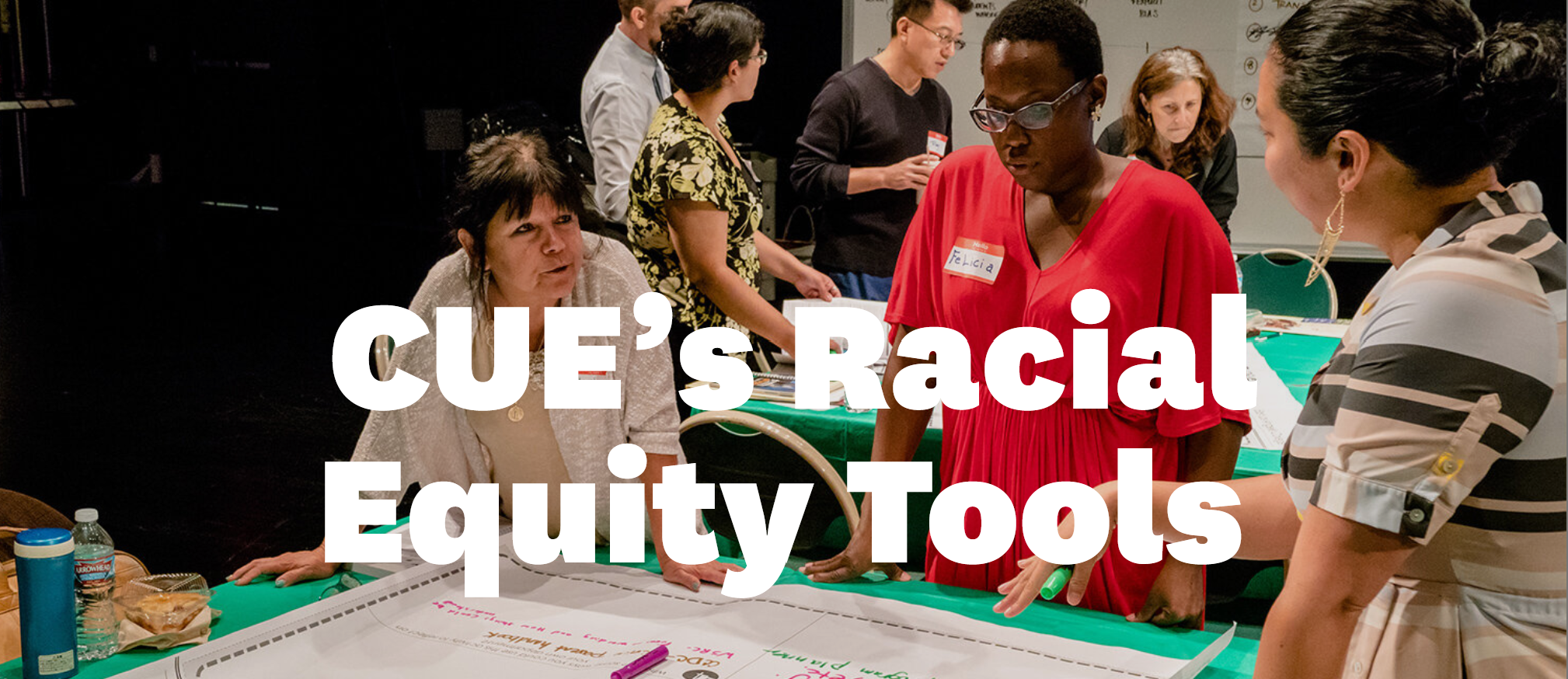
CUE’s Racial Equity Tools aim to change the minds, hearts, and practices of faculty, staff, and leaders—all of whose collaboration is essential to achieve racial equity in higher education.
Each tool prompts reflection on the racialized characteristics of everyday practices, setting the foundation for change.
Using the Racial Equity Tools
Each tool prompts reflection on the racialized characteristics of everyday practices, setting the foundation for change.
We borrow a principle of community organizing: to bring about transformation, you have to meet people where they are—and give them tools to build their own knowledge and self-change.
These tools reflect this idea and are inherently flexible approaches with practical activities embedded within them. Though the tools are organized into four phases, they naturally support a race-focused continuous improvement process: inquiring and observing, experimenting with changes, evaluating progress, and learning.
SO WHO ARE THESE TOOLS FOR?
Practitioners who have not dedicated much time or thought to reflecting on race and racism in higher education before. These practitioners may recognize diversity in a student body, but may not make a point to measure whether diverse racial / ethnic groups are equitably succeeding—or may see disparities in student outcomes, but attribute those disparities to students’ effort or abilities rather than inadequate institutional policies and practices. The tools will help them build a new actionable, equity-minded view.
Practitioners who are aware of the role race and racism play in higher education, but aren’t sure what to do about it. The tools will help them apply inquiry to deepen their understanding and identify problematic policies or practices to reform.
Practitioners who are well-versed in issues of race and possess a critical race perspective, but are struggling to get colleagues or leaders on board. The tools can help these practitioners speak to those that fall in either of the first groups mentioned, and build a shared vocabulary and plan for inquiry-driven, anti-racist action.
In the past, CUE facilitators have helped groups use these tools, but you may use them on your own—the content in phase one will help orient you and your team.
READY TO USE CUE’S RACIAL EQUITY TOOLS? START HERE
Why racial equity?
CUE’s equity efforts are focused specifically on race and ethnicity in light of historical and current oppression in American education. Our goal is to achieve equity in outcomes for racially minoritized students—both in attainment and retention as well as in access to scarce opportunities like honors programs and high-value degrees such as in STEM fields.
For this to happen, there must be a shared understanding that colleges and universities have and continue to perform poorly for minoritized students, and that racial inequities are an outcome of structures, policies, and practices that are presumed to be race-neutral.
This is the root of equity-mindedness, a term that CUE coined to refer to the mode of thinking exhibited by practitioners who are willing to acknowledge that their policies and practices have not been designed to produce racial equity and that they need to be rethought and remediated in order to do so.
“I wanted to transform racial equity from an ideal that was embraced in the abstract to something that was actionable and measurable.”
Dr. Estela Mara Bensimon,
University Professor & Dean’s Professor in Educational Equity,
Founding Director, Center for Urban Education
How do we foster equity-mindedness?
The tools use action inquiry to help practitioners develop critical race consciousness: an understanding of how the way they operate produces racial inequity. The tools enable practitioners to see how racism is reflected in what they notice and fail to notice, what they consider good and not good, and what they say and fail to say—even in the absence of underlying intent.
Rooted in the tradition of critical action research, the tools provide practitioners with a structured process of studying their own actions and artifacts of practice. By learning to use disaggregated data and inquiry to “see” who, by race and ethnicity, is and isn’t served by those actions and artifacts, practitioners can begin to make contextualized changes.
Ready to use CUE’s Racial Equity Tools?
START HERE
“An equity-minded practitioner commits to lifelong learning, actively participates in dismantling systems of oppression, and believes in the limitless potential of Black, Latinx, Native American, and other minoritized student groups.”
Jennifer Ortiz
English Department Chair, LA Trade Tech College